Is a Hair Transplant Worth It? An Honest Cost-Benefit Analysis
All-inclusive
FUE Hair Transplant
from€2,150$2,490£1,850CA$3,460A$3,500NZ$4,260

Is a Hair Transplant Worth It? An Honest Cost-Benefit Analysis
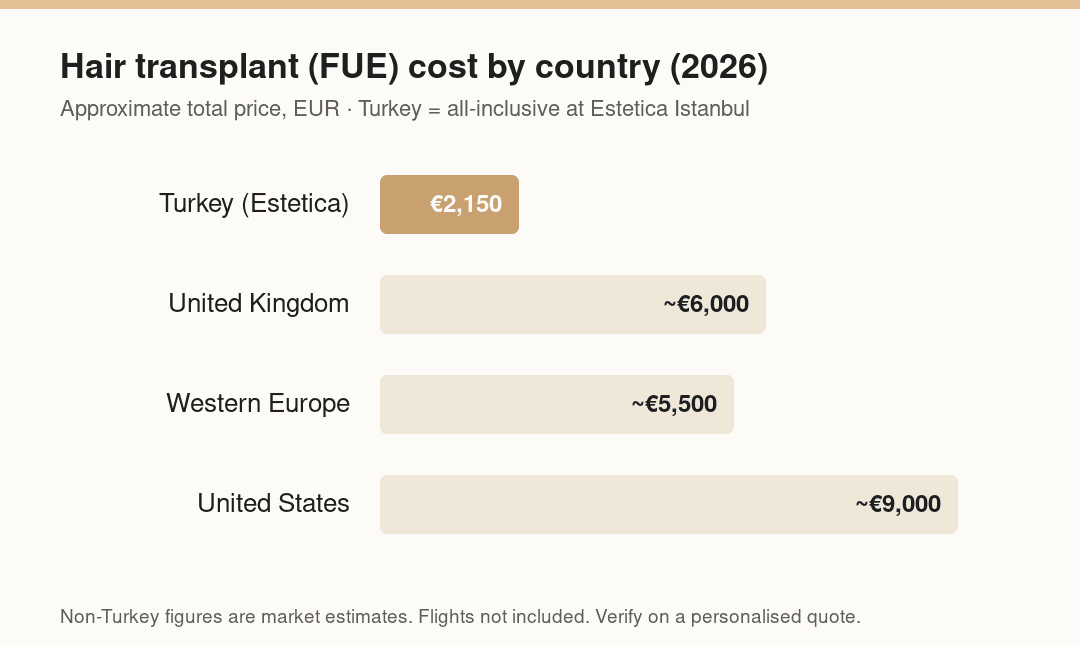
Hair transplantation represents a significant financial investment (€2,000-6,000), and whether it's 'worth it' depends on individual factors including financial circumstances, psychological impact of hair loss, professional implications, and personal values. This honest analysis examines the financial cost-benefit, psychological ROI, professional/social benefits, and potential risks to help you make an informed decision. The reality is that hair transplants deliver excellent value for properly selected candidates but may be inappropriate for others. Understanding realistic expectations and your personal situation is essential before committing to treatment.
All-inclusive
FUE Hair Transplant
from€2,150$2,490£1,850CA$3,460A$3,500NZ$4,260
Financial Cost-Benefit Analysis
Hair transplant cost (€2,000-6,000) is high upfront but must be compared to lifetime costs of alternative approaches. Minoxidil (topical hair growth drug) costs approximately €20-40 monthly (€240-480 annually), and most patients require lifetime treatment—discontinuing minoxidil results in hair loss resuming within 3-6 months. Over 30 years, minoxidil costs €7,200-14,400 plus the psychological burden of daily application and dependency. Finasteride (oral hair loss medication) costs €10-30 monthly (€120-360 annually), similarly requiring lifelong use. Combining both medications for 30 years costs €10,800-19,440. A hair transplant's €2,500-4,000 cost (Turkish pricing) is recovered financially after approximately 6-10 years of medication costs, and represents the permanent, lifelong solution. For patients likely to use medications for decades anyway, transplantation delivers superior financial value despite higher initial cost.
Combination Approach Financial Reality
Many patients use optimal approach combining hair transplantation with ongoing medical management (finasteride and/or minoxidil) to maximize retention of transplanted hair while preserving remaining native hair. This approach costs €2,500-4,000 for transplant plus €120-480 annually for medications—substantially less than medications alone but more than transplant alone. The combined approach delivers superior long-term outcomes and hair retention compared to either modality alone. From a financial perspective, transplant plus medications is efficient—the procedure provides permanent baseline density while minimal medications maintain results. For patients committed to medication use, the transplant adds modest additional cost while delivering significantly superior outcomes.
Psychological and Quality-of-Life ROI
Financial analysis alone misses the psychological and quality-of-life value of hair restoration. Hair loss impacts psychology disproportionately to its health significance—individuals with significant hair loss report increased anxiety, depression, social withdrawal, and reduced self-confidence. Studies document that hair transplant patients experience substantial psychological benefits including improved self-esteem, enhanced social confidence, and increased quality of life. These psychological benefits persist indefinitely since transplanted hair is permanent. Assigning financial value to improved mental health is difficult, but the psychological ROI of hair transplantation is often exceptional—patients frequently report that the procedure was life-changing despite the financial cost. For individuals experiencing significant psychological impact from hair loss, this psychological ROI may outweigh financial considerations.
Professional and Social Benefits
Research suggests that hair density impacts professional opportunities and social interactions—individuals with fuller hair are perceived as more competent and confident in professional contexts. While this shouldn't be accepted as fair or just, it reflects social realities. Some professions (sales, media, entertainment, management) place greater emphasis on appearance, making hair restoration potentially more valuable professionally. Hair transplant patients anecdotally report enhanced professional opportunities, improved networking effectiveness, and increased dating success—benefits difficult to quantify financially but potentially significant long-term. For younger patients early in their careers, hair transplantation may enable career trajectory improvements that justify the investment. For older patients with established careers, professional benefits are more modest.
Who Should NOT Get Hair Transplants
Hair transplants are inappropriate for some individuals despite being suitable candidates medically. Patients with unrealistic expectations—expecting return to hair density equivalent to their youth—will likely experience disappointment since transplant density is limited by available donor hair. Patients with active body dysmorphic disorder (obsessive focus on perceived appearance flaws) should address psychological issues before considering an elective procedure, as their expectations will likely remain unmet regardless of outcome. Patients unable to afford the procedure without financial hardship should not proceed—excellent results provide poor psychological benefit if financial stress accompanies them. Patients with active substance abuse issues, severe untreated psychiatric conditions, or poor capacity for post-operative care should address these issues before the procedure. Very young patients (under 22-25) with aggressive hair loss patterns should consider waiting until patterns stabilize to avoid multiple procedures. Female patients with diffuse hair loss (affecting entire scalp rather than specific areas) may not be appropriate candidates since transplantation creates artificially dense areas adjacent to thinning areas.
The Satisfaction Rate Data
Clinical literature consistently documents 85-95% patient satisfaction with hair transplant outcomes, with 75-80% reporting results exceeded expectations. These satisfaction rates are exceptionally high compared to most surgical procedures. Satisfaction correlates more strongly with realistic expectations and clear communication than with absolute density achieved—patients understanding the limitations of their donor supply and maintaining realistic goals are consistently more satisfied. Even patients achieving modest results (20-30% density improvement) report high satisfaction if expectations were managed appropriately. The high satisfaction rates suggest that for appropriately selected candidates, hair transplantation delivers genuine value—both psychological and financial.
Potential Risks and Complications
Hair transplantation, while generally safe, carries small but real risks. Infection is rare (less than 1% of cases) when performed in hygienic settings like JCI-accredited facilities. Scarring in the donor area is usually invisible but can be visible in very short hairstyles if extensive grafts were harvested (less than 2% of FUE cases). Temporary or permanent numbness at donor and recipient sites occurs in 10-15% of cases but is usually mild and resolves over months. Shock loss (temporary shedding of native hair) affects 10-20% of patients and resolves within 3-6 months. Infection, serious complications, or results dramatically worse than expected occur in less than 1% of cases performed at reputable clinics. The risk-benefit ratio is generally favorable, with low serious complication rates justifying the modest risks for appropriately selected candidates.
The 5-Year and 10-Year Value Proposition
Five years post-transplant, the financial value becomes apparent—a patient has spent €2,000-4,000 on the transplant versus €1,200-2,400 in medication costs that would have continued indefinitely. The transplanted hair is now permanent, requiring no special maintenance beyond normal shampooing. The psychological benefits have compounded through five years of improved confidence and social engagement. The professional benefits—if relevant to your field—have accumulated through enhanced networking and improved interactions. At ten years, the financial advantage is undeniable—the €2,000-4,000 investment has returned multiple-fold in medication savings. Most patients report that hair transplantation was one of their best personal investments.
Making Your Personal Decision
Deciding whether hair transplantation is worth it requires honest self-assessment: How much does hair loss impact your psychology? Can you afford the procedure without financial hardship? Do you have realistic expectations about achievable density? Are you committed to post-operative care? Will transplant results align with your personal values and life situation? Estetica Istanbul's consultations specifically address these personal factors through detailed discussions beyond purely medical considerations. We want to ensure that every patient choosing transplantation has carefully considered the financial and psychological dimensions and is genuinely prepared for the procedure. For appropriate candidates with realistic expectations and adequate resources, hair transplantation is demonstrably worth the investment—delivering permanent results, substantial psychological benefits, and favorable long-term financial value.



Get Your Free Consultation
Our partner medical team will review your case and send you a personalized treatment plan within 24 hours.
€500 deposit, refundable for 14 days or until your flight is booked · Our guarantee