Gynecomastia Surgery in Turkey: Cost, Recovery & How to Choose (2026)
Gynecomastia — the development of excess breast tissue in men — affects an estimated 30–65% of men at some point in their lives. For many, it never resolves on its own, and no amount of exercise removes glandular tissue. Surgery is the only permanent solution. If you've researched the procedure in the UK, US, or Western Europe, you've likely been quoted £4,500–7,000 or more. In Turkey, the same surgery in a JCI-accredited hospital typically starts from €2,950, all-inclusive. This guide explains exactly what drives that difference, what the procedure involves, and how to choose a clinic without getting burned.
How much does gynecomastia surgery cost in Turkey?
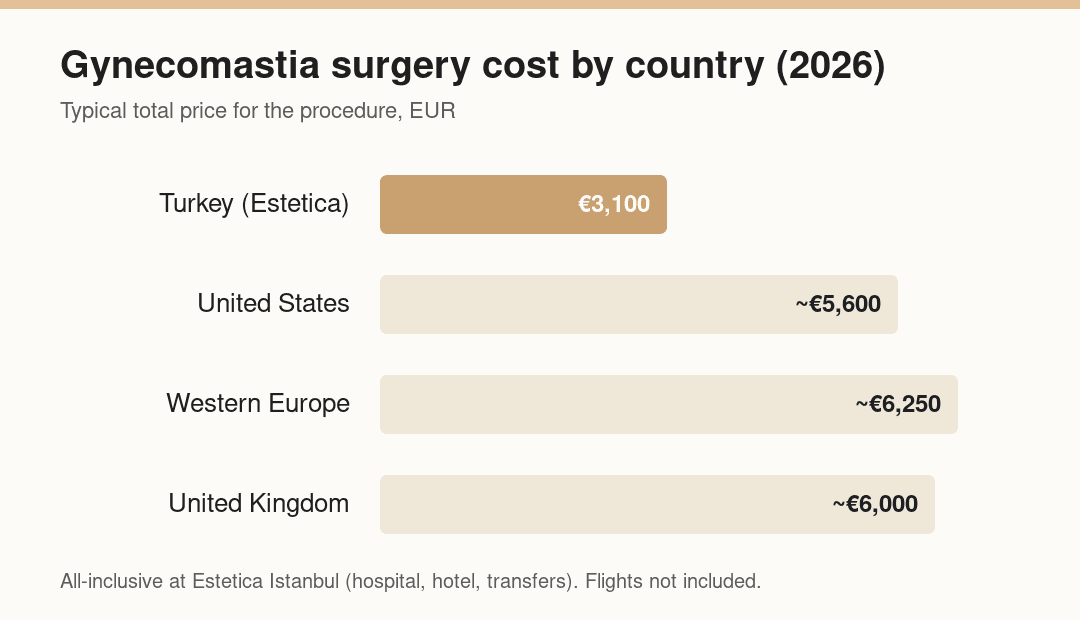
At Estetica Istanbul, gynecomastia surgery starts from €2,950 as an all-inclusive package. That figure covers the surgeon's fee, the operating theatre and one night in a JCI-accredited partner hospital, anaesthesia, your compression garment, post-operative medication, and recovery-hotel nights with airport transfers. The only thing it never includes is your flights. By comparison, gynecomastia surgery in the UK typically runs £4,500–7,000, in the US $5,000–8,000, and across Western Europe €5,000–7,500 — often before consultation fees, garments, and follow-up are added. A €500 deposit secures your booking; the balance is settled before the procedure.
Why is it so much cheaper than the UK or US?
Lower price does not mean lower quality, and it's worth understanding why. Turkey's cost advantage comes from structural factors, not corner-cutting: lower clinical overheads and staff costs, a favourable exchange rate, and an enormous volume of medical-tourism procedures that lets hospitals operate efficiently. The surgeons performing these operations are board-certified specialists working in hospitals accredited by the same international body (JCI) that accredits leading Western hospitals. The instruments, implants where relevant, and sterilisation standards are identical. What you are not paying for is the premium overhead of a Harley Street or Beverly Hills address.
What the procedure actually involves
Gynecomastia correction usually combines two techniques. Liposuction removes excess fatty tissue through small incisions, while glandular excision removes the firm breast tissue that liposuction alone cannot address — this is the step that makes the result permanent. The right combination depends on whether your case is predominantly fatty, glandular, or mixed, which is assessed during consultation. The operation is performed under general anaesthesia and typically takes 60–120 minutes. In most cases it is a day-case or single-overnight procedure.
Recovery timeline: what to expect
Most patients are walking the same day and fly home after 2–3 days, once a post-operative check clears them. A compression garment is worn for 4–6 weeks to control swelling and help the skin retract. Desk-based work is usually resumed within 5–7 days; light exercise after about three weeks; and chest or upper-body training after roughly six weeks, with your surgeon's clearance. Final results settle over three to six months as swelling fully resolves. Note that flying too soon after any surgery carries a small clot risk — never book a return flight earlier than your clinic advises.
Is gynecomastia surgery in Turkey safe?
Safety depends far more on where and with whom you have surgery than on which country you're in. The genuine risks of medical tourism come from clinics that operate in non-accredited facilities, skip proper consultation, or push package deals without a surgical plan. The protections to insist on are simple: a JCI-accredited hospital, a board-certified surgeon, a documented consultation that reviews your medical history, and a clear written aftercare plan. Estetica Istanbul operates as a medical-tourism agency coordinating board-certified surgeons and JCI-accredited hospitals — so the same standards apply as you would expect at home.
How to choose a clinic
Before you pay a deposit anywhere, confirm four things: that the surgery takes place in an accredited hospital (not an unlicensed clinic), that you can see the operating surgeon's credentials, that real before-and-after photos of comparable cases are available, and that aftercare and revision policy are in writing. Be sceptical of prices that look implausibly low and of reviews that are uniformly perfect — both are red flags. A reputable provider will give you a named surgical contact and answer hard questions directly.
Will the results be permanent?
Yes, provided glandular tissue is removed. Because liposuction alone leaves the gland behind, surgery that includes excision delivers a permanent result. Significant future weight gain or certain medications and steroids can still affect the chest, but the treated glandular tissue does not grow back.
Will there be visible scars?
Incisions are small and placed discreetly — typically around the edge of the areola and in the natural crease — so scars are minimal and fade considerably over the first year.
How soon can I travel home?
Most patients fly home 2–3 days after surgery, following a post-operative check. Your recovery-hotel nights are built into the package for exactly this window.
Thinking about gynecomastia surgery? Request a free, no-obligation assessment and a personalised quote from Estetica Istanbul. Send a few photos and your history, and our team will explain your options honestly — including whether surgery is the right route for you.


Get Your Free Consultation
Our medical team will review your case and send you a personalized treatment plan within 24 hours.